
Acupuncture needle sizing guide
If you're not paying attention, identifying needle sizes can easily become confusing. Here's a quick guide for when you're shopping for acupuncture needles. Please prioritize referring to a textbook, or consult with a licensed practitioner.
'Cun' = 寸 = one finger's width
As a unit of measurement for acupoints on the body, 1cun (寸) is equivalent to the length of one finger's width of a human thumb; this is what is commonly referred to as body-based cun. Body-based cun can only be used to measure acupoints on one's own body, which is to say, everybody will have a different cun measurement. For example, Yao Ming's 1cun cannot be used to measure the 1cun and/or acupoints on the body of a young child.
| Inches in TCM | Millimeter |
| 0.5 cun寸 | 15 mm |
| 1 cun寸 | 25 mm |
| 1.5 cun寸 | 40 mm |
| 2 cun寸 | 50 mm |
| 2.5 cun寸 | 65 mm |
| 3 cun寸 | 75 mm |
| 4 cun寸 | 100 mm |
| 5 cun寸 | 125 mm |
| 6 cun寸 | 150 mm |
* You may have noticed that this '1寸cun' is not twice the length of '0.5寸 cun', and it also differs from the body-sized inch. Generally, '1寸cun' for acupuncture needles is larger than 1 body-based cun for most people.
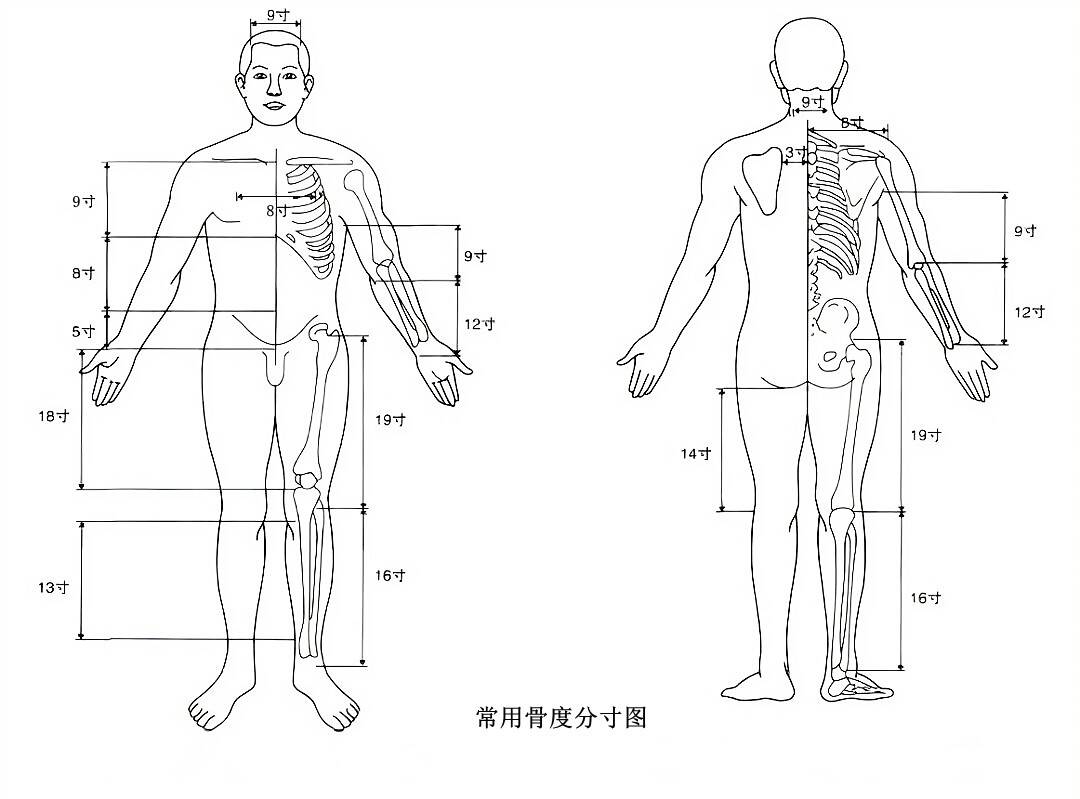
How long is "1 cun" exactly?
In clinical practice, the accuracy of an acupoint location directly affects its therapeutic effects. Therefore, practitioners have long devised a complete set of methods for locating acupoints.
These include the bone measurement method, the surface landmark method, the finger measurement method, and convenient acupoint location methods.
The bone measurement method uses joints as landmarks to measure the size and length of various parts of the body, and then calculates the proportions to locate acupoints. Regardless of gender, age, height, or weight, the bone measurement method can be used to determine acupoints. For example, the distance from the midpoint of the anterior hairline to the midpoint of the posterior hairline is 12 cun, and the distance from the elbow crease to the wrist crease is 12 cun.
As can be seen from the bone measurement method, the so-called '1cun' in the process of locating acupoints in traditional Chinese medicine is not the same for everyone. The length from the elbow crease to the wrist crease is longer for a tall person than for a short person. Therefore, the location of acupoints in TCM is not measured by using a ruler with graduations on the patient, but is based on the patient's bone landmarks. This reflects the idea of individualized treatment in TCM.
Quick Acupoint Location for Home Healthcare
For the general population, the bone measurement method is too technical. Simpler methods such as surface landmark location, convenient acupoint location, and finger measurement can be used for acupoint location.
The surface landmark location method utilizes natural landmarks such as the five senses, hair, nails, nipples, navel, and muscle depressions to locate acupoints. For example, the navel is used to locate the Shenque acupoint, and the midpoint between the two nipples is used to locate the Tanzhong acupoint.
Convenient acupoint location method is even easier to perform; for example, the midpoint of the line connecting the tips of both ears is used to locate the Baihui acupoint, and the tip of the elbow when the shoulder is drooping and the elbow is bent is used to locate the Zhangmen acupoint.
The finger measurement method uses the patient's fingers as the standard for measuring acupoints. Similar to the bone measurement method, the width of the thumb and the space between the fingers when they are held together varies among men and women, young and elderly, tall and short, overweight and underweight people. Therefore, the specific lengths of 1 cun and 3 cun measured by the finger measurement method will also vary for different people.
1. The width of the first joint of the thumb is 1 cun (寸)
The *Essential Prescriptions Worth a Thousand Gold Pieces* states: "The first joint of the middle finger is one cun, though its length may vary; therefore, the width of the first joint of the thumb is one cun." The width of the first joint of the middle finger is 1 cun, and the width of the first joint of the thumb is also 1 cun.
2. The width of four fingers together is 3 cun (寸)
The width of four fingers together is also called the "one-fu(夫) method," where "one fu" was 3 cun. Ge Hong of the Eastern Jin Dynasty, in his *Emergency Prescriptions to Keep Up One's Sleeve*, states: "The patient's hand is placed horizontally, with four fingers together; this is called one fu." Here, "fu" is a unit of measurement; the width of the index, middle, ring, and little fingers together is one fu, or 3 cun.
3. Three fingers together: 2 cun (寸)
With the index, middle, and ring fingers together, draw a horizontal line using the middle joint crease as a reference. The width of the three fingers together is approximately 2 inches.
4. Two fingers together: 1.5 cun (寸)
With the index and middle fingers together, draw a horizontal line using the middle joint crease as a reference. The width of the two fingers together is approximately 1.5 inches.
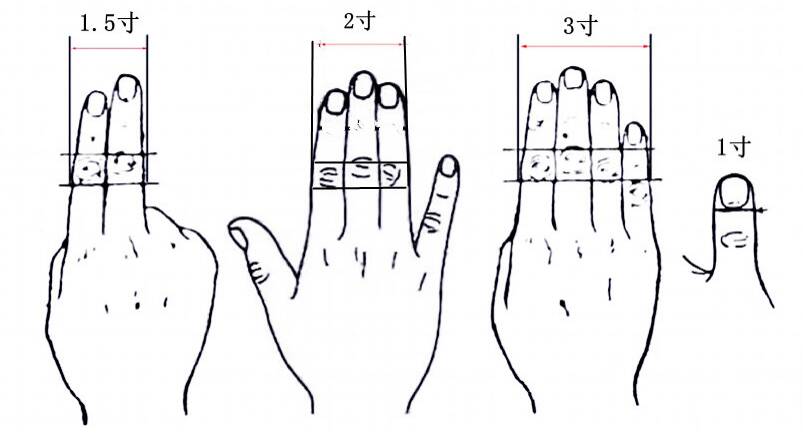
It should be noted that the finger-based acupoint location method is a summary of long-term clinical practice. Although it is simple to operate, it is not very accurate. It can be used in home health care activities such as massage, cupping, and scraping, where the acupoint location requirements are not high. Licensed Practitioners will locate acupoints based on bone measurement method and body surface landmark methods.
We stock more than 60 different sizes of HUANQIU needles in-store (here and here), including a few discounted ones! Contact us or drop by for more information. Our prices range from $2.00 - $7.50 per box of 100.
Articles referenced:
https://acureausa.com/needle-size-conversions/
https://nordicacupuncture.com/en/chooseneedles
https://health.iqilu.com/stjk/jkyw/2025/0414/5800242.shtml